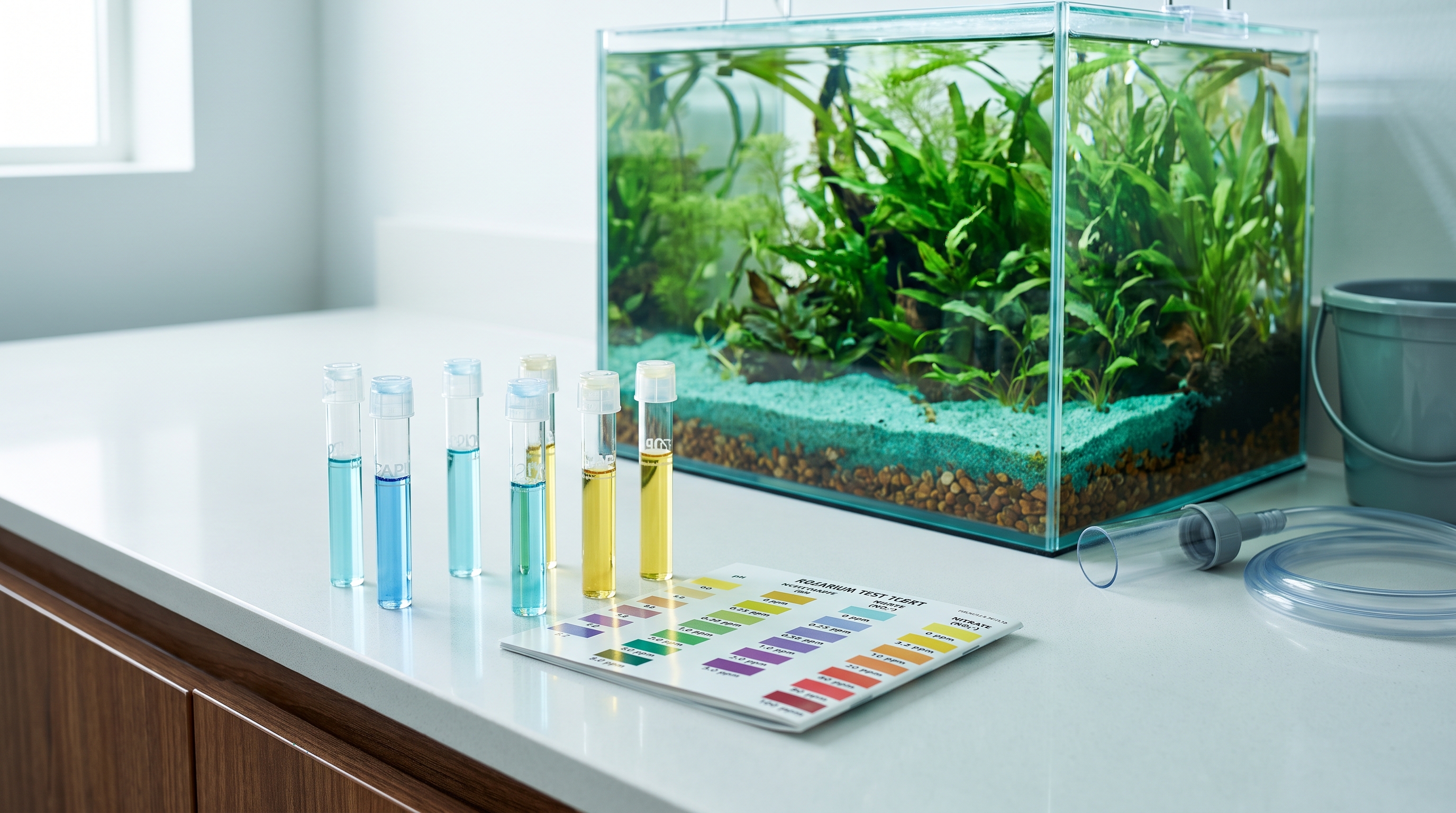
Nitrate is the last stop in your aquarium’s nitrogen cycle, and the fastest way to lower it is a partial water change with clean, dechlorinated water. Nitrate lives in the water column, not in your gravel or rock, so swapping out water directly removes it. Beyond that, you lower nitrate by feeding less, keeping up with maintenance, adding live plants, and rethinking any filter media that traps waste. There’s no magic additive that beats the simple math of dilution.
That’s the short answer. The rest of this guide explains why nitrate builds up, what level is actually safe, and the specific habits that keep the number down for good instead of yo-yoing every week.
What Nitrate Is
Every aquarium runs on the same chemistry. Fish produce waste. Uneaten food and dead plant matter rot. All of that releases ammonia, the biggest dissolved waste in your tank.
Ammonia is highly toxic. So your biofilter’s bacteria convert it, first into nitrite, then into nitrate. Nitrite is also highly toxic. Nitrate is the mild one at the end of the chain.
That conversion is the whole point of cycling a tank. If any of this is new to you, our guide to the aquarium nitrogen cycle walks through each step. The key thing to understand here: nitrate is what a healthy, cycled tank produces on purpose. Your bacteria are supposed to make it.
The problem is that nothing in a standard freshwater tank removes nitrate the way bacteria remove ammonia and nitrite. It just accumulates. That’s why lowering it is a job you do, not a job your filter does for you.
Why nitrate is less dangerous, not harmless
Fish absorb nitrate through their gills far less readily than ammonia, which is why it’s much less toxic. According to fish veterinarian Dr. Jessie Sanders (DVM, DABVP in Fish Practice), writing for petMD, most fish tolerate up to around 20 mg/L, though sensitivity varies a lot by species.
But “less toxic” isn’t “safe.” As TFH Magazine’s Sara Jackson points out, many fish show no symptoms until nitrate hits 100 ppm or higher. The trap is what happens below that. Studies have shown that long-term exposure to sub-critical nitrate stresses fish, makes them more prone to disease, stunts the growth of young fish, and lowers breeding success.
So you’re not managing a poison that kills on contact. You’re managing chronic stress that quietly wears your fish down.
What Nitrate Level Should You Aim For?
Here’s a target you can use.
- Ideal: 5 to 10 ppm
- Acceptable ceiling: around 20 ppm
- Too high: 20 to 50 ppm and climbing
- Danger zone: 100 ppm and up
Freshwater tanks can sit at the higher end of “ideal,” which is one advantage freshwater keepers have. Marine and reef setups push for near zero. Even the saltwater community, which tolerates a bit more nitrate than reef keepers, aims for 10 ppm or less to match natural seawater, as the team at Melev’s Reef describes.
Freshwater fish are generally more tolerant of nitrate than saltwater fish. That’s real, but don’t read it as permission to let the number ride. Lower and stable beats high and tolerated every time.
One more reason to keep it down: algae. An algae bloom is often the first visible clue that your nitrate is high. Algae will grow at levels as low as 10 ppm, and micro and macro algae both love the stuff. Excess algae can crash your oxygen overnight and swing your pH, which stresses fish in its own right.
You can’t see it, so you have to test it
Nitrate is invisible and odorless. There’s no way to eyeball it. The only way to know your level is a test kit, matching the color of your sample against the chart.
A single reading tells you where you are today. What matters is the trend across weeks: is your number holding steady, creeping up, or dropping after you change habits? Logging each test makes that trend obvious. You can track ammonia, nitrite, and nitrate over time with a free tool like Nitrify, which reads your cycling stage and gives you a plain Safe, Watch, or Act verdict on each entry.
Track it all in one place with {{ .Site.Params.appName }}.
Get Nitrify →What’s Driving Your Nitrates Up?
Before you fix the number, find the source. High nitrate is almost always the result of one or more of these.
Overfeeding. This is the big one. Every flake your fish don’t eat rots and feeds the ammonia-to-nitrate chain. More food means more waste means more nitrate.
Too much livestock for the tank. More fish produce more waste. An overstocked tank generates nitrate faster than reasonable maintenance can remove it.
Skipped water changes. Since nothing consumes nitrate naturally, it only leaves when you take it out. Miss enough changes and it just climbs.
Waste-trapping filter media. This one surprises people. Bioballs, biowheels, filter pads, foam blocks, and under-gravel filters are all great at growing bacteria, but they also trap detritus that breaks down into more nitrate. The keeper at Melev’s Reef battled nitrates for years and only broke through after pulling out a three-year-old under-gravel filter and a biowheel unit packed with bioballs.
Nitrate in your tap water. Sometimes the tank isn’t even the problem. Some tap and well water carries nitrate before it ever touches your aquarium. The US Environmental Protection Agency caps nitrate in drinking water at 10 mg/L, so perfectly legal source water can still arrive with a real amount already in it. If your tap reads 20 ppm, no water change will ever get you below 20. Test it and find out.
How to Lower Nitrates: The Methods That Work
Now the practical part. Here are the levers, roughly in order of how much they matter.
1. Partial water changes (the workhorse)
Water changes are the single most effective way to lower nitrate, because they attack it directly. Nitrate sits in the water column, so when you remove and replace water, you remove nitrate in exact proportion.
The math is simple. Change 25 percent of the water and you cut roughly 25 percent of the nitrate, as long as your replacement water is nitrate-free. This is the “dilution is the solution to pollution” principle, and it’s the backbone of nitrate control.
A few rules that make it work:
- Always dechlorinate your replacement water. Chlorine and chloramine harm both fish and your bacteria colony.
- Match temperature roughly so you don’t shock your fish.
- Vacuum the substrate while you drain to pull out trapped waste before it becomes more nitrate.
One important caution: dechlorinated water is not automatically “safe” water. Dechlorinator neutralizes chlorine, but it does nothing about ammonia or nitrite. On a healthy cycled tank that’s fine. On a crashed or uncycled tank, treat the underlying cycle first.
2. Bring a high number down gradually
If your nitrate is very high, don’t fix it in one giant change. A sudden swing in water chemistry stresses fish, sometimes more than the nitrate itself did.
The Melev’s Reef approach is a good model. Facing 80 ppm in a 29-gallon tank, small 5-gallon changes barely moved the needle: 80 down to 60, then right back up. What worked was three larger changes in one week, about 33 percent each time. That brought nitrate down to 20 ppm. Then the routine shifted to a steady 7 to 10 gallons every two weeks to hold it there.
The lesson: several moderate changes over a few days beat one dramatic swap. Spread the correction out.
Guessing how far one change will take you is hard to do in your head. This is where a dilution preview helps. Enter your current level and change size, and Nitrify Pro estimates where you’ll land, so you can plan a safe sequence instead of testing blind after every bucket.
🪣 Nitrify Pro's dilution preview shows what a water change will do to your nitrate before you lift the bucket.
Try Nitrify →3. Feed less, and feed smarter
Cutting food at the source slows nitrate production before it ever starts. Feed only what your fish finish in a couple of minutes. Remove uneaten food. Consider a fasting day each week for many community fish, which is normal and healthy for them.
Less input means less waste to convert. It’s the cheapest nitrate control there is, and it costs you nothing but restraint.
4. Rethink waste-trapping filtration
If your filter is full of pads and sponges that clog with gunk, that trapped detritus is a nitrate factory. You don’t want to throw out your biological filtration, that’s what keeps ammonia and nitrite at zero. But you do want to keep it clean.
Rinse mechanical media regularly so waste doesn’t sit and break down. Critically, rinse it in old tank water you just drained, never under the tap. Tap water’s chlorine kills the beneficial bacteria your media holds. A full media swap does the same thing and can partially restart your cycle. Gentle rinsing in used tank water preserves the colony while removing the gunk.
5. Add live plants
Plants use nitrate as fertilizer. Fast-growing stem plants and floating plants are especially hungry and can meaningfully lower your reading over time.
Plants come with a catch, though. When plant matter decays, it releases ammonia back into the system, which then cycles right back into nitrate. So a heavily planted tank still needs maintenance, and dead leaves need to come out. Think of plants as an assist to your water-change routine, not a replacement for it.
6. Advanced options: sumps and refugiums
For keepers ready to go further, a sump adds water volume, which dilutes nitrate simply by giving it more water to spread through. A refugium grows macroalgae that pulls nitrate out as it grows. The Melev’s Reef tank added both later on and saw lasting improvement. These are bigger projects, but they’re a proven path for tanks that fight nitrate no matter what.
Building a Routine That Holds
Lowering nitrate once is easy. Keeping it low is about habit.
The keeper at Melev’s Reef put it well: the fix wasn’t a product, it was becoming “more meticulous” with water changes. Nitrate Sponge alone, used weekly, never solved the problem. Consistent removal did.
A workable freshwater routine looks like this:
- Test nitrate on a regular schedule, at least weekly while you’re getting it under control, so you catch a climb early.
- Change 20 to 30 percent of the water on a set cadence, weekly or every two weeks depending on your stocking and your readings.
- Vacuum the substrate during changes to remove trapped waste.
- Keep feeding modest and pull uneaten food.
- Rinse mechanical media in old tank water when it clogs.
Adjust the cadence to your own numbers. A lightly stocked planted tank might hold 10 ppm on a change every two weeks. A busy community tank might need weekly attention. Your test results tell you which tank you have.
If you want reminders and a running trend so this doesn’t slip, Nitrify handles the test schedule and charts your last 30 days, so you can see at a glance whether your routine is holding the line.
A Note on New Tanks and Panic
A quick reality check for newer keepers. If your tank is still cycling, some rising nitrate is normal and expected. It means your bacteria are working: ammonia and nitrite are being converted as they should. Our guide to cycling a tank covers what those numbers should do.
Don’t confuse a bacterial bloom with a nitrate problem, either. Cloudy water in a young tank is usually a harmless bloom that clears on its own, not a sign your water is fouling. We cover that in why your fish tank water is cloudy.
And don’t fear water changes during cycling. The old warning that a water change “resets your cycle” is overstated. Your bacteria live on surfaces, your filter media, gravel, and glass, not in the water you drain. A water change removes water and nitrate, not your colony. Letting ammonia or nitrite climb to dangerous levels is far worse than the small slowdown a big change might cause.
When Nitrate Has Already Hurt Your Fish
If your fish are showing signs of nitrate stress, act on the water, not just the symptoms. Per petMD, nitrate poisoning looks like:
- Lethargy
- Decreased appetite
- Skin irritation or redness
- Increased or labored breathing
- Sudden death, sometimes with no warning
The treatment is the same as the prevention: partial water changes to bring nitrate down, done gradually so you don’t shock already-stressed fish. Then fix the root cause, whether that’s overfeeding, overstocking, skipped changes, or trapped waste, so it doesn’t come back.
One honest caveat. This is guidance from a fellow hobbyist, not a vet. If fish are actively dying and your water tests don’t explain it, an aquatic veterinarian is the right call.
Frequently Asked Questions
What is a safe nitrate level for a freshwater aquarium? Aim for 10 ppm or less, and treat 20 ppm as a soft ceiling. Most freshwater fish tolerate up to about 20 mg/L, but long-term exposure to lower “sub-critical” levels still stresses them, so lower and stable is always better.
How do I lower nitrates fast? A partial water change is the fastest, most reliable method. It physically removes nitrate-laden water and swaps in clean, dechlorinated water. Several moderate changes over a week beat one giant change that shocks your fish.
Does a water change lower nitrates? Yes. Nitrate sits in the water column, so replacing water directly dilutes it. Change 25 percent and you remove roughly 25 percent of the nitrate, assuming your new water is nitrate-free.
Do live plants reduce nitrates? They help. Plants use nitrate as fertilizer, and fast-growing species can make a real dent. But if plants decay, they release ammonia back into the system, so plants support water changes rather than replace them.
Can high nitrates kill my fish? Yes, over time. Nitrate poisoning develops slowly and shows up as lethargy, poor appetite, and labored breathing. Many fish show no symptoms until levels get very high, which is why regular testing matters more than watching for signs.
Is my tap water adding nitrates? It can. Some municipal and well water carries measurable nitrate straight from the tap. The EPA allows up to 10 mg/L in drinking water, so test your source water to learn the floor you’re working against before blaming the tank.
Track Your Water With Nitrify
Lowering nitrate comes down to watching a trend and acting before it climbs, which is what Nitrify is built for: log your ammonia, nitrite, and nitrate and it reads your cycling stage and gives a one-line Safe, Watch, or Act verdict on every test, free, with a 30-day trend chart and reminders. When you’re bringing a high number down, Nitrify Pro adds the dilution preview so you can plan how big a water change to make and roughly where it’ll land, along with a per-parameter safety breakdown so you know each number’s target range. It’s a one-time $6.99, no subscription.